Asset register
Create a controlled list of maintainable assets, locations, responsibilities, condition, criticality, related documents, and replacement planning references.
Connect every critical asset to a task, frequency, responsible owner, completion record, finding, and corrective action—then show leadership what is slipping before failure decides the priority.
A useful preventive maintenance plan answers seven questions: what asset, where, who owns it, what task is required, when it is due, what proves completion, and what happens when the result is unacceptable.
Begin with life-safety, water-control, electrical, vertical-transportation, access, structural, fire, and continuity systems. Add manufacturer, warranty, contract, inspection, and professional requirements. Then expand to service-quality and appearance assets.
Create a controlled list of maintainable assets, locations, responsibilities, condition, criticality, related documents, and replacement planning references.
Define the inspection, cleaning, lubrication, testing, servicing, calibration, treatment, and replacement tasks associated with each asset.
Record why each task is daily, monthly, seasonal, annual, usage-based, or condition-based: law, code, manufacturer, warranty, contract, specialist, or site experience.
Plan labor, vendors, parts, access, permits, shutdowns, resident notice, safety controls, approvals, and dependencies before the due date.
Require date, technician, readings, checklist, photographs where appropriate, findings, parts, exception notes, and reviewer acceptance before closure.
Convert failed inspections and abnormal readings into prioritized work with an owner, target date, interim control, cost path, and verification.
A score helps sort work; it does not override qualified judgment, mandatory inspection or maintenance requirements, emergency conditions, or manufacturer and warranty instructions.
| Cadence | Review | Output |
|---|---|---|
| Daily or weekly | Critical alarms, leaks, life-safety exceptions, access, active shutdowns, overdue critical work, and vendor mobilization. | Immediate control, escalation, and assigned corrective action. |
| Monthly | Scheduled-versus-completed work, repeat issues, open findings, backlog age, parts constraints, vendor service, and emergency work. | Exception report with owners and dates. |
| Quarterly | System trends, condition changes, contract performance, shutdown planning, budget effects, capital dependencies, and seasonal readiness. | Updated risk and priority plan. |
| Annually | Asset register, task basis, frequencies, warranties, contracts, replacement links, staffing, tools, and next-year budget. | Approved annual plan and resource forecast. |
| After an event | Failure, storm, incident, inspection finding, renovation, manufacturer notice, or material operating change. | Root-cause review and revised task or control. |
“Completed” is not a useful status when the record does not identify the asset, task, result, exception, and next action.
State the asset or location, observed condition, priority reason, requester, date, access needs, and any immediate control already in place.
Name the responsible team or vendor, target date, scope, approval, parts, safety requirements, resident notice, and escalation contact.
Record arrival, work performed, readings, materials, photographs when appropriate, deviations, and any additional condition discovered.
Confirm function, cleanup, access restoration, documentation, warranty effect, invoice match, and acceptance by the appropriate reviewer.
Create separate owned work for deferred repairs, parts, monitoring, engineering questions, proposal requests, or capital planning.
Update failure codes, task instructions, frequency, inventory, vendor expectations, training, budget, and replacement assumptions.
A small dashboard is more useful than dozens of counts. Start with preventive work ratio, schedule completion, repeat issue rate, work-order cycle time, backlog age, inspection closure, emergency work, and critical-system test completion.
Define every formula, source, owner, cadence, and limitation. Segment results by asset class, priority, internal versus vendor work, and cause before drawing conclusions.
Identify maintainable assets, locations, responsibilities, condition, criticality, required tasks, frequency, instructions, safety or access needs, labor or vendor ownership, parts, evidence of completion, findings, and corrective follow-up.
Review execution monthly, priorities and backlog quarterly, and the full asset and task basis at least annually. Also reassess after a failure, inspection, project, warranty change, storm, or material change in use or condition.
Preventive work is planned to inspect, service, test, or replace an asset before failure. Reactive work responds after a fault, complaint, damage, or service interruption. Both should remain visible in the same operating picture.
No. Frequencies and methods must follow applicable law, codes, permits, manufacturer instructions, warranties, contracts, specialist recommendations, and site-specific risk.
Use these evidence checks to build a property-specific action plan. The rows define controls; they are not completed inspections or verified property findings.
These rows define suggested controls, not completed property findings. Interpret each check against your actual property records, responsible role and acceptance evidence. See the review instructions and reuse terms.
12 checks shown
No check matches those filters. Try a different term or area.
| Review area | Check | Evidence to request | Decision question |
|---|---|---|---|
| Assets | Reconcile the asset register | Model location identifier and installed date | Is the serviced asset correctly identified? |
| Assets | Classify criticality | Service impact and professional assessment | Which failure needs immediate escalation? |
| Tasks | Verify task basis | Manufacturer instructions warranty and professional direction | Why is this task and interval appropriate? |
| Tasks | Specify acceptance | Test method readings and pass criteria | What evidence constitutes a pass? |
| Scheduling | Assign coverage | Competent owner vendor and backup | Who performs and verifies the task? |
| Scheduling | Plan access | Resident notice shutdown and access constraints | Can work proceed safely on the planned date? |
| Execution | Record failed tasks | Results deficiencies photographs and action | What remains unresolved? |
| Execution | Separate deferral | Deferral authority reason and interim control | Has the risk of delay been reviewed? |
| Execution | Link repair history | Asset-linked corrective work and cause | Is the same failure recurring? |
| Reporting | Review overdue critical work | Due dates criticality and escalation log | What decision cannot wait? |
| Reporting | Update after a project | Closeout asset list manuals and settings | Did the project change the maintenance plan? |
| Review | Check plan effectiveness | Failure history and revised task rationale | Should the plan change? |
A fictional property replaces equipment but keeps a maintenance plan tied to the retired asset. The new unit has different records and service dependencies.
Original fictional example · no completed client assignment or property inspection is represented.
| Record to obtain | Review question or calculation |
|---|---|
| New asset identifier and operating documentation | Retire the old plan without losing its history |
| Handover records | Use the applicable equipment guidance and qualified advice |
| Current maintenance responsibilities | Verify parts, access and evidence requirements for the new plan |
Useful working output: A current asset-linked plan with ownership and an initial completion check.
Open each challenge to test the reasoning against a different finding.
Check: Reconcile the opening task list, new tasks, completed tasks, cancellations and remaining backlog by asset and risk class.
Decision effect: Correct the denominator and explain cancellations before interpreting the higher completion rate as improved maintenance.
Check: Read the technician findings, measurements and exception notes. Confirm whether a failed test created a corrective work order with an accountable owner.
Decision effect: Distinguish a completed inspection from a serviceable asset. Carry unresolved defects into the corrective plan.
Adapt the record request to authorized access, governing documents and the actual property. The example does not verify any unknown input or replace a professional conclusion.
Capital Project Warranty Tracking and Defect Follow-Up · More operations and maintenance examples
Recurring tasks compete with urgent repairs.
Do not count scheduled work as performed maintenance.
Match a sample completed task to asset identity, instructions, service record and exception disposition.
Original proposed coordination checks · adapt to authorized access, the actual obligation and the appropriate professional review. These are not findings about your property.
Follow the related handoff workflow · Read the review definitions
Completing scheduled work and restoring an asset are different outcomes. Track both: a completed inspection can reveal a defect that still needs a corrective work order.
Identify location, task and frequency source.
Record who performed the task and when.
Separate a normal result from an open defect.
Verify the repair and restore service.
A fictional property has 40 preventive tasks due and completes 32 on time: 80%. If five completed inspections reveal defects, those findings remain open corrective work. An 80% schedule result does not imply that 80% of the equipment is safe or reliable.
Original hypothetical arithmetic example. The amounts describe a fictional scenario, not observed property performance or a recommended target.
Continue with Maintenance Backlog Triage: Consequence, Readiness and AgeEnter non-negative values using the same scope and period. This calculation stays in your browser tab.
An overdue critical test may matter more than several late appearance tasks. Review consequence and required instructions before a blended percentage.
If emergency work consumes planned capacity, record what slipped, the asset affected and the recovery arrangement.
A service visit proves attendance. A dated reading, failed-test record and corrective verification establish a stronger chain of evidence.
A generic inspection task can miss a component replaced during a project. Reconcile the asset ID, model, location, manufacturer instructions, warranty conditions, and criticality before assigning a maintenance interval.
Distinguish completed, deferred, inaccessible, and failed tasks. A technician attendance record is not a passing test; retain readings, findings, deficiencies, and the action required.
Review repeated failures and overdue critical work with the facilities lead. Change the plan when condition evidence or professional advice changes, retaining the rationale and approved version.
Find checklists and data definitions · Explore operations and maintenance
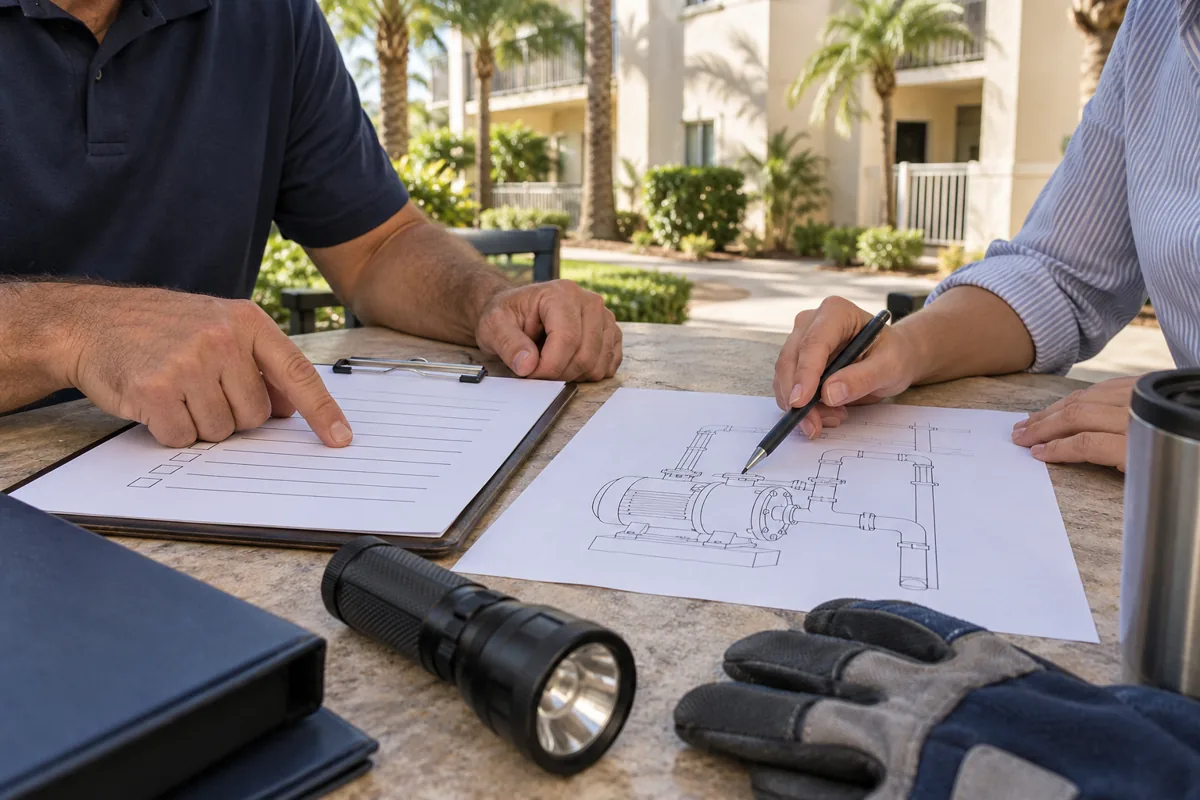
A checklist becomes useful when it identifies the asset, the inspection task and the evidence to examine. An equipment diagram is context for a qualified reviewer; it does not establish the current condition, safe procedure or acceptance of a repair.